
















Scientists Have Invented AI That Makes Your Household Objects Emotionally Needy
A Carnegie Mellon research project can make your plant miserable, your heater frustrated, your skateboard lonely, and your dumbbells disappointed in you. If you want that.
Imagine your houseplant needs watering and can let you know its distress. Or your heater is irritated that you keep leaving it on when you’re not even in the room and scowls at you when you come back in.
Normally, none of these household objects has anything to say, and you happily could keep ignoring them. But researchers at Carnegie Mellon University have developed a device that gives them the next best thing: a tiny digital personality that can look happy, bored, tense, or thoroughly disappointed with its owner. Apparently, you don’t have enough technology in your house, so it’s time for more gadgets. Judgy ones.
The devices are called OATs, short for Object-Agent Twins, and they work rather like Tamagotchis attached to ordinary household objects. (I am writing this article assuming you know what a Tamagotchi is. You can still buy them, if you’re curious.)
But here, instead of looking after a virtual pet, the idea is that the virtual pet represents something you already own.
Your plant now has feelings
OATs were created by Carnegie Mellon PhD researcher Daehwa Kim and professor Chris Harrison. The project was presented at the ACM Symposium on User Interface Software and Technology in Detroit earlier this month, where it received two honourable mentions.
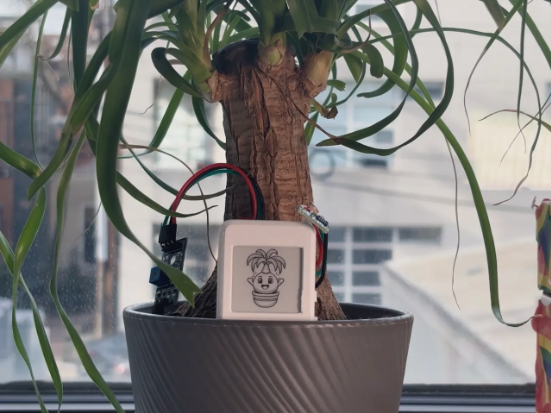
Each OAT is a small electronic module containing an E Ink screen. Sensors can monitor things such as temperature, humidity, light, movement, soil moisture and whether anyone is nearby.
Users give their OAT a name, tell the system what object it’s attached to, and select the appropriate sensors. Google’s Gemini AI then creates a little pixel-art character with different emotional expressions. The idea seems to be that you anthropomorphise them and they guilt you into doing stuff.
One of the researchers’ examples is a sea onion plant called Green Monster. When the plant needs water, its digital counterpart becomes tense and looks concerned. Water it, and Green Monster becomes happy again.
Another example is Mr Refrigerator, who is attached to a communal office fridge, enjoys being useful and becomes bored if nobody opens the door. I don’t see the point, but maybe it would be fun. Then there’s a space heater called Heater Man that gets frustrated if it is heating an empty room or making the place unnecessarily warm. Which is kind of useful.
Suddenly, neglecting your possessions becomes slightly more personal. It reminds me a bit of the toaster in Red Dwarf that is constantly hassling people to toast bread. Again – kind of cool, but probably annoying.
Don’t disappoint the dumbbell
There is a practical idea behind the cute faces, though.
Most smart devices display numbers, alerts, charts, or graphs. OATs translate the same sort of information into something humans are particularly good at recognising and reacting to: emotion.
Someone testing the system attached an OAT to a dumbbell. The little character effectively kept track of whether the weight was being used, encouraging its owner to exercise regularly because they did not want to disappoint it.
The researchers found that the devices could alert people to its condition or encourage changes in the owner’s own behaviour.
And even better, the hardware is surprisingly cheap. According to Kim, the main OAT module costs around $20 to build, although additional sensors can add to that.
There is one obvious drawback. The current prototype lasts only around three or four days between charges, falling to roughly a day when used with a sound-level sensor. So, you will need to charge them more often. There is probably an OAT device to remind you to do that too, so hooray.
Should your fridge really be sad?
The project also raises a more interesting question about how readily people form emotional attachments to machines.
Humans already name cars, bicycles and other possessions. My iPad and PS5 both have names, but that could just be me. Giving an object a face that reacts to our behaviour pushes that relationship considerably further. (I don’t know if a needy PlayStation would be a good thing for productivity, though.)
I am also pretty sure lots of demanding screens would get annoying after a while.
Kim is aware of these problems. OATs have deliberately been kept simple rather than turned into fully conversational AI companions. They express emotions on their screens, but they do not spend the day trying to get you chatting.
For now, OATs remain a research project rather than something you can order online. Kim has been encouraged to sell kits but has not decided whether to turn the idea into a commercial product.
The potential list of objects is almost unlimited. The researchers suggest kettles, books, chairs, water bottles, pill boxes, coffee cups, toilets and even bags of potatoes.
Which means the smart home of the future may eventually contain dozens of devices monitoring our behaviour.
As a lazy man, I don’t think I want to see disappointment on little digital faces everywhere I look. I saw this story and thought it was worth sharing, but apart from maybe a plant on my desk occasionally badgering me for a watering, I don’t know if this is for me.
I did find Tamagotchis pretty cool, though, so we’ll see.
Here’s a video if you want to learn more:
This post has an affiliate link. It is for Tamagotchis, so it was worthwhile.