









Can Brain Damage Unlock Hidden Genius? The Strange Science Of Accidental Savants
Can a blow to the head really unlock an extraordinary hidden ability? In a handful of remarkable cases, apparently it can.
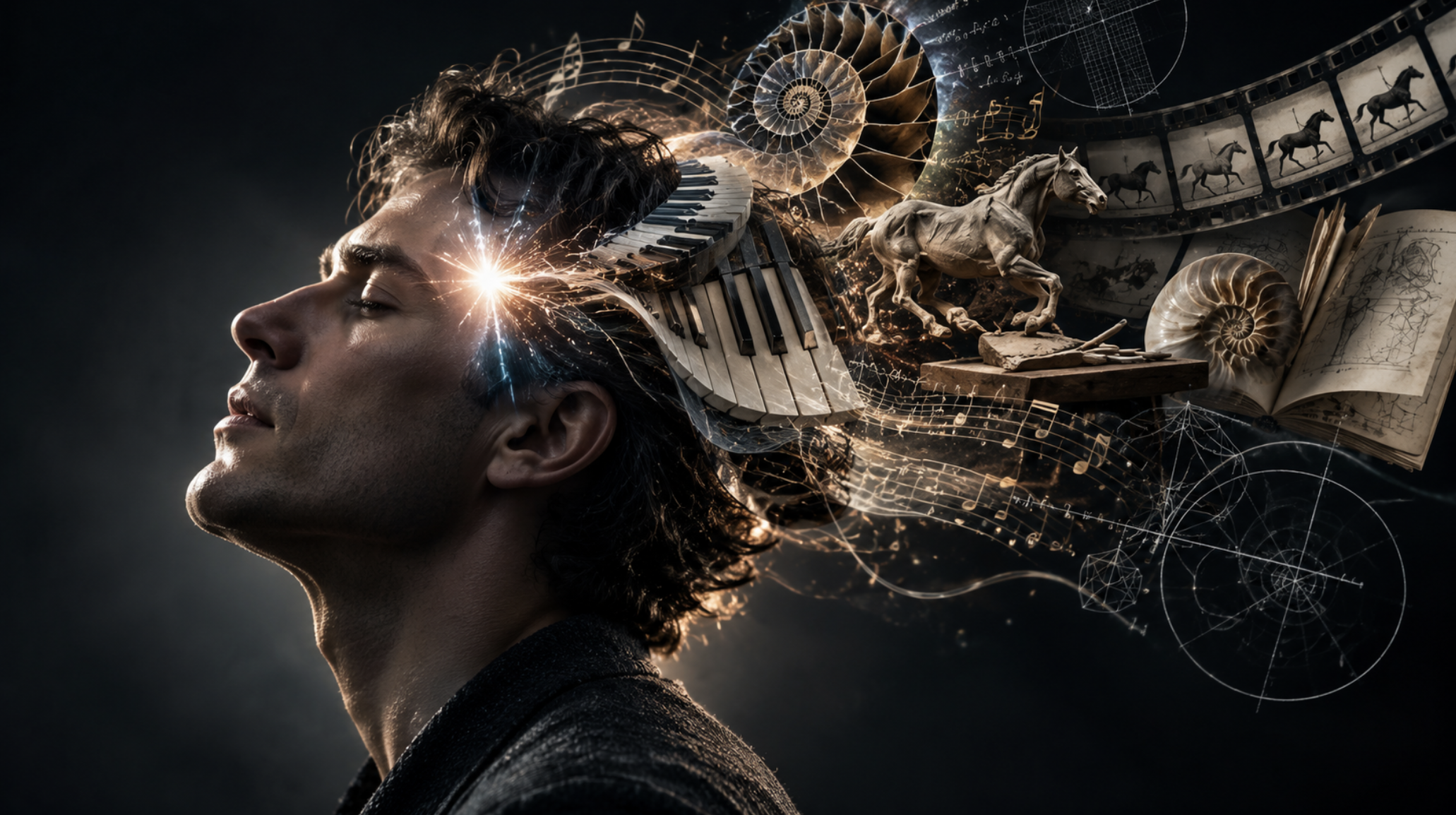
It sounds like the unlikely origin story of a particularly cultured superhero: someone suffers a serious blow to the head and wakes up able to play the piano, produce complicated mathematical drawings or remember almost every day of their life.
You’ve probably heard such stories and assumed (if you have a logical mind) that they are heavily exaggerated. Strangely enough, though, the phenomenon is real.
It is known as acquired savant syndrome, an extremely rare condition in which someone develops an unusual artistic, musical, mathematical or memory-related ability following an injury or disease affecting the brain.
That doesn’t necessarily mean somebody gets hit on the head and instantly becomes Mozart. The reality is considerably stranger and, in many cases, comes with serious consequences.
Here are some of the most remarkable examples.
Derek Amato suddenly discovers the piano
In 2006, Derek Amato was visiting family when he tried to catch a football while diving into the shallow end of a swimming pool.
It didn’t go well.
Amato smashed his head into the bottom of the pool and suffered a severe concussion. In the weeks that followed, he experienced headaches, memory problems and around 35 per cent hearing loss in one ear.
Then, four days after the accident, something much stranger happened.
While visiting his friend Rick, Amato noticed an electronic keyboard in the room and felt an unexpected urge to sit down and play it.
This was peculiar because he couldn’t play the piano. He had messed around with rhythm guitar in a garage band when he was younger but had never learnt the keyboard or shown any particular interest in doing so.
Amato sat down anyway. His fingers began moving across the keys, and he found himself improvising chords and melodies. His friend stared at him in disbelief.
Amato carried on for five or six hours.
The ability wasn’t quite as magical as some later accounts made it sound. Amato still couldn’t simply sit down and play any tune on demand, and he didn’t claim to have suddenly become a classically trained virtuoso. What appeared was an ability to improvise his own music instinctively.
Nevertheless, the change was extraordinary.
Playing became something of a compulsion, and he was incredibly talented. He eventually recorded music professionally and performed on stage with renowned jazz-fusion guitarist Stanley Jordan.
Tony Cicoria becomes obsessed with classical music
Orthopaedic surgeon Tony Cicoria had an even more dramatic encounter with fate.
In 1994, the 42-year-old doctor was attending a family gathering at a lakeside pavilion in upstate New York. He stepped outside to use a payphone just as a storm was approaching.
Moments after finishing the call, lightning struck.
Cicoria later recalled seeing a flash shoot from the telephone towards his face before he was thrown backwards. His heart apparently stopped, and another person at the gathering performed CPR. Remarkably, he survived.
For a while afterwards, Cicoria suffered some memory problems, but neurological tests found nothing seriously wrong, and within weeks he was back at work. Then came the strange part.
Around a month after the lightning strike, Cicoria suddenly developed what he called an ‘insatiable desire’ to listen to classical piano music.
Before the accident, classical music had barely interested him. He had taken a few piano lessons as a child but abandoned them. Now, though, he couldn’t get enough of it.
He bought recordings of Chopin, acquired a piano and began teaching himself to play. Soon afterwards, he began hearing music in his own head and felt compelled to compose it.
Music eventually became a huge part of his life alongside medicine, and Cicoria began giving public performances of his own compositions.
Neurologist Oliver Sacks later documented his extraordinary case in Musicophilia. (You can check it out here.) (Affiliate link.)
Jason Padgett begins seeing mathematics everywhere
Before 2002, Jason Padgett had very little interest in mathematics. He had dropped out of college, spent much of his time partying and described himself as having never progressed much beyond basic maths at school. I’m sure you can imagine the type.
But one night he was violently attacked outside a bar, suffered a concussion and, after the assault, began noticing that the world looked different.
Instead of seeing smooth curves and flowing movement, he perceived geometric shapes, lines and patterns everywhere. Water circling a plughole, sunlight through trees and ordinary objects suddenly appeared to contain complicated mathematical structures.
He began obsessively drawing what he saw.
Padgett had no mathematical vocabulary to explain the shapes, but eventually a physicist saw some of his drawings and recognised that they appeared to represent sophisticated geometric and mathematical ideas.
He encouraged Padgett to study mathematics properly.
He did, and this time, Padgett loved it. He became fascinated by geometry, fractals and the mathematical structures underlying the natural world. His striking drawings have since become almost as famous as his story.
Padgett’s transformation also had a darker side. Following the attack, he developed severe anxiety and obsessive-compulsive behaviours and became frightened of leaving his home. Like others on this list, his gift came with a price.
Orlando Serrell remembers almost every day
Orlando Serrell’s transformation began with something considerably more mundane.
In 1979, when he was ten years old, Serrell was playing baseball when the ball struck him hard on the left side of the head. He fell down but soon got back up and continued playing. He didn’t tell his parents and received no medical treatment, although he suffered headaches afterwards.
Some time later, Serrell realised that he had developed an extraordinary ability.
Give him a date after the accident, and he could usually tell you what day of the week it was, what he had been doing and even what the weather had been like. His autobiographical memory appeared to have become vastly more detailed than before.
He also became unusually good at calendar calculations, rapidly working out the day of the week for particular dates.
Alonzo Clemons can sculpt an animal from memory
Alonzo Clemons suffered a serious head injury after a fall when he was around three years old. The accident left him with major developmental disabilities. He struggled with speech, reading and writing and required considerable assistance in everyday life.
But another ability emerged. Clemons became fascinated with sculpting animals.
Show him an animal briefly, either in person or in a photograph, and he can recreate its shape in remarkable three-dimensional detail from memory.
He doesn’t need sophisticated equipment either. As a child, when modelling clay wasn’t available, he reportedly used whatever he could find, including wax, cooking fat, and even material scraped from the road.
His speed is equally impressive. He can create a detailed animal figure in minutes and larger, more elaborate sculptures from memory.
Clemons eventually became a recognised professional sculptor, with his work exhibited and sold internationally. His is one of the cases most often cited by researchers studying acquired savant syndrome.
Jon Sarkin couldn’t stop making art
Jon Sarkin’s story is slightly different because the change did not follow a simple blow to the head. In 1988, Sarkin was a chiropractor living in Massachusetts when he suffered a brain haemorrhage while playing golf.
His medical problems eventually led to brain surgery. During the procedure, complications caused serious neurological damage and a stroke. Sarkin survived, but he was left with permanent problems, including hearing loss in one ear, double vision and difficulties with balance. His personality also changed.
Most unexpectedly, Sarkin developed an overwhelming urge to create art.
He had occasionally doodled before the stroke, but afterwards, drawing became compulsive. He produced dense, unusual pictures packed with faces, words, pop-culture references and repeated patterns. Eventually, he abandoned chiropractic work and became a professional artist.
His pictures were exhibited internationally and attracted attention from publications including The New Yorker and The New York Times. His work also appeared on album artwork, and several pieces entered the collection of the Centre Pompidou in Paris.
Pulitzer Prize-winning journalist Amy Ellis Nutt later wrote an entire book about him, Shadows Bright as Glass. (Affiliate.) Sarkin continued producing art for decades until his death in 2024.
Was Eadweard Muybridge another accidental genius?
The famous photographer Eadweard Muybridge is sometimes added to lists of people whose creativity dramatically increased following brain injury. But it’s less likely and more complicated.
His story is certainly intriguing, although describing him as an acquired savant is probably going too far.
In 1860, Muybridge was badly injured when a stagecoach crashed in Texas. He suffered a serious head injury and spent years recovering. People who had known him before the accident later claimed that his personality had changed dramatically afterwards. The previously sociable businessman became more volatile and eccentric.
Volatile is probably understating it. In 1874, Muybridge discovered that his wife had been having an affair with a man named Harry Larkyns. Muybridge tracked him down and shot him dead. A jury acquitted him on the grounds of justifiable homicide, despite the killing quite clearly being premeditated by modern standards. It was a different time.
Although he was clearly more violent, Muybridge’s creative career after his accident was extraordinary.
He became fascinated by photography and eventually worked with businessman and former California governor Leland Stanford, who wanted to settle a much-debated question: did all four of a galloping horse’s hooves ever leave the ground simultaneously?
Muybridge devised a system of cameras positioned alongside a track and triggered in rapid succession as a horse passed them. The resulting sequence showed that, yes, all four hooves do leave the ground at once.
More importantly, it captured movement as a series of individual images.
Muybridge later developed the Zoopraxiscope, which projected sequences of images from rotating glass discs to create the illusion of movement. It was an important precursor to cinema.
Whether the stagecoach accident somehow unlocked Muybridge’s creativity is impossible to prove. His personality certainly changed after his injury, but unlike people such as Clemons or Padgett, he isn’t regarded as a clear-cut case of acquired savant syndrome.
So how can a brain injury create a new ability?
For years, one popular explanation suggested that the brain’s left hemisphere suppresses abilities associated with the right. Damage to certain areas of the left side, so the theory went, might release previously hidden artistic or perceptual abilities.
Some neurological evidence supports versions of this idea, particularly in patients with damage to areas of the left temporal lobe. But the familiar idea that the left brain is simply ‘logical’ while the right brain is ‘creative’ is a huge oversimplification.
Modern theories are, annoyingly, much more complicated.
One possibility is something catchily called paradoxical functional facilitation. Damage to one neural system may reduce the inhibition it normally places on another, allowing previously less prominent processes to become much stronger.
Changes in brain connectivity and neuroplasticity may also play a role. Some researchers believe savant abilities could result from the brain processing information in a much more detailed, less abstract way than it normally would.
The problem is that acquired savant syndrome is so rare that there simply aren’t enough well-studied cases to provide a definitive answer. So things remain pretty vague.
What these stories definitely don’t show is that receiving a blow to the head is some kind of shortcut to genius. Most of those involved often suffered permanent pain, sensory problems, obsessive behaviour, memory difficulties or severe disability. Whatever abilities emerged came with consequences nobody would willingly choose.
What the cases do suggest, however, is that something extraordinary can occur. Our brains may be capable of processing information in ways that normally remain inaccessible to us. How or why remains a mystery.
A version of this article originally appeared on my Substack. You can check that out here if you enjoy this kind of thing.