


















The Loudest Man in the World, a Duck at a Presidential Briefing, and Pigeons with a Liver Compass

As the world is a grim place, I thought I would share some good/interesting news about the loudest man, a duck that got famous in Mexico (and is cute), and how pigeons are talented (despite being basically airborne rats). Enjoy.
The Loudest Man Who Shouted ‘Now’ at 122.4 Decibels
I find a lot of the newer records to be dumb, as they are often someone doing something novel rather than impressive. I saw one on TV where a guy broke the record for the most amount of pegs on his face. The previous record holder was himself. In contrast, being the loudest man or woman is something admirable and has a history dating back through the ages. I love a good shout.
So I was excited to read that Joseph McGrail-Bateup, a 58-year-old air-conditioning cleaner from Canberra, Australia, has been recognised by Guinness World Records as the loudest man in the world after shouting a single word at 122.4 decibels.
The word was ‘now’.
The record attempt took place in a Canberra radio studio on the 2nd of May, with professional acoustic verification. A few weeks later, Guinness confirmed the result. McGrail-Bateup, who also serves as an official town crier, had managed a shout roughly comparable to a chainsaw, an ambulance siren at close range, or a rock concert. (A good one, like Motorhead.)
The only downside is that his record beat the previous mark of 121.7 decibels, set in 1994 by Annalisa Flanagan, a schoolteacher from Northern Ireland. Her record-breaking word was ‘quiet’. Which I found immensely pleasing.
McGrail-Bateup told reporters that this was not something he could properly practise for. The trick, he said, was to save his voice for the day itself. That may have been wise, because after the attempt, his voice was reportedly gone for days.
He is no amateur shouter – if that’s a thing. McGrail-Bateup became Canberra’s honorary town crier in 2017 and has competed in other loudness contests. In 2024, he won one with a 98-decibel cry of “Oyez”, the traditional call used by town criers to get attention.
As ways of getting into the Guinness World Records go, I respect loudness.
Merlin the Duck Goes to the Presidential Palace
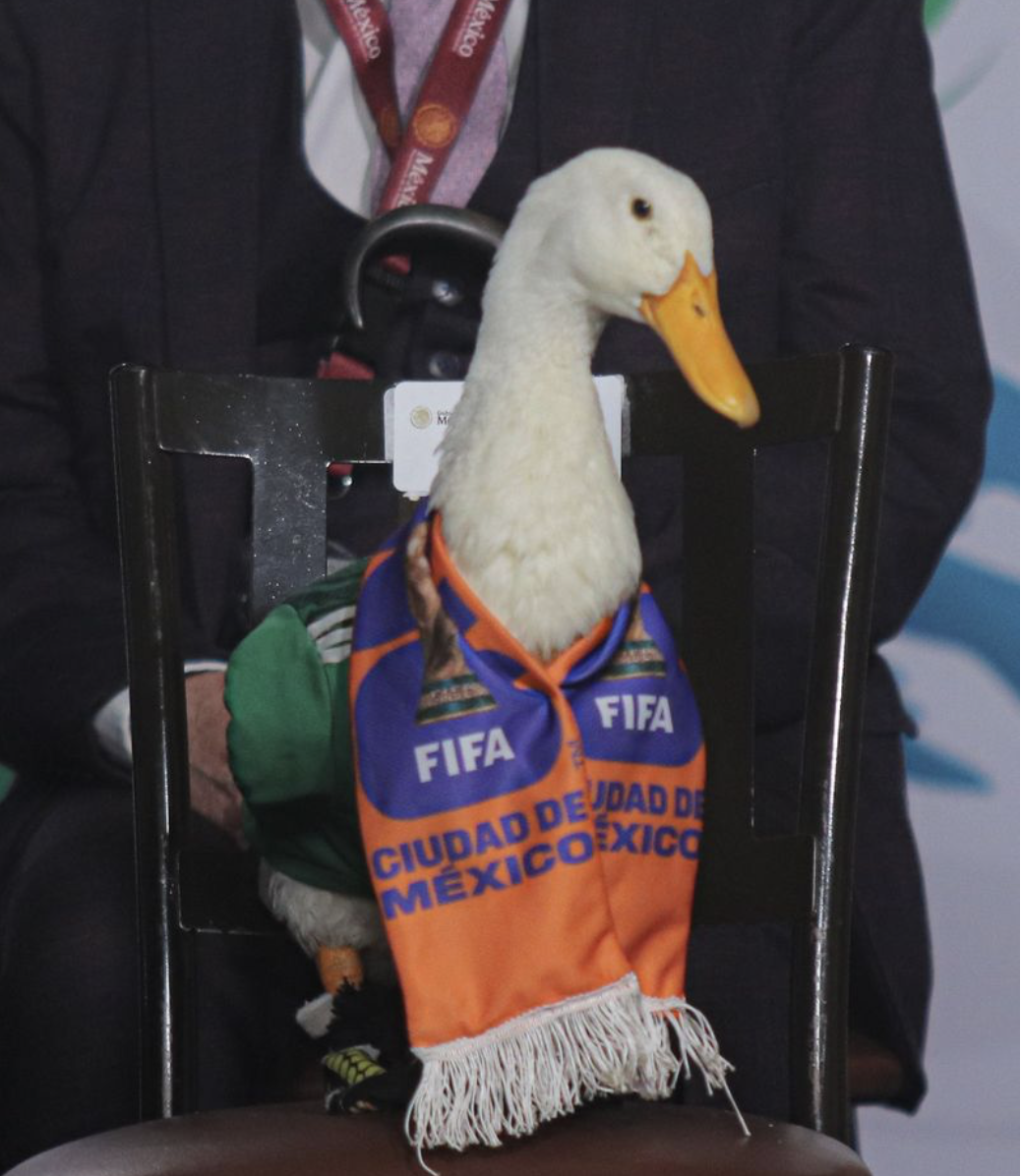
At a recent presidential news briefing in Mexico City, President Claudia Sheinbaum found herself sharing the spotlight with a duck. In case you were unsure, the duck is pictured above.
The duck’s name is Merlín. I don’t know why. It arrived wearing a Mexico football shirt and a small FIFA tie, accompanied by its owner, Carla Gómez, a street vendor, and her two sons. Merlín has become something of an unofficial World Cup mascot in Mexico, after videos of him mingling with football fans began spreading online.
During the briefing, Merlín sat among officials, attracted cameras, and generally performed the basic duties of a celebrity duck, which appear to involve being dressed for the occasion and not answering any questions. Sheinbaum posed for pictures with him before moving the briefing along to other, possibly more serious matters.
In case you are after some celeb gossip: Merlín is two years old, wears protective shoes when he goes walking, and enjoys pork carnitas tacos on Sundays. His owner has said she hopes to register his image as a trademark, as the attention around him has changed her family’s life.
Pigeons May Navigate With Their Livers
Homing pigeons have long been famous for their ability to find their way back across large distances. The exact mechanism behind that ability has been studied for decades, with scientists investigating the birds’ eyes, ears, beaks and brains. Which makes sense.
But a new study suggests that one answer to their innate compass superpowers may be hiding in the liver.
Researchers from the Max Planck Institute of Animal Behavior and the University of Bonn found iron-rich immune cells in pigeons’ livers that may help the birds detect Earth’s magnetic field. These cells, known as macrophages, break down old red blood cells and store iron. The researchers believe they may act as part of an internal compass.
In tests, pigeons deprived of these cells (don’t ask how) had difficulty finding their way home under overcast skies, when the sun was not available as a navigational cue. On sunny days, they could still orient themselves, suggesting that pigeons may rely on more than one system when navigating.
The finding does not close the case entirely. Scientists still need to understand how information from the liver would be transmitted to the brain, and whether similar systems exist in other animals. It would be pretty handy. Still, the idea that pigeons may partly navigate by using iron-filled immune cells in their livers is a reminder that even familiar animals can remain deeply strange.
I live in a city, so I generally find them annoying, but I admire a cool skill.
This post is an experiment
As I said at the start, the world feels a bit down at the moment. (I was going to joke, ‘unless you’re a billionaire,’ but they all seem weird or angry or both.) So in amongst my already weird blend of history, curiosity, reviews, and occasional rants, I am going to have the odd week looking at fun things. Like the loudest man and a cute, famous duck.
Hopefully, this will cheer up the world a fraction of a tiny percent. Next week – something grim and historical.