











Tree Spirits And Good Fortune: The Beautiful Ghosts Who Protect Thailand’s Forests
I wrote recently about an angry Thai ghost with a detachable head, so it is time to look at some beautfiul tree spirits that protect native trees.
Thailand’s spiritual world isn’t all horror, walk down almost any street and you’ll see colourful ribbons tied around trees. They’re not decorations. They’re offerings to the spirits who live there and they are everywhere. You even see them in the middle of Bangkok.
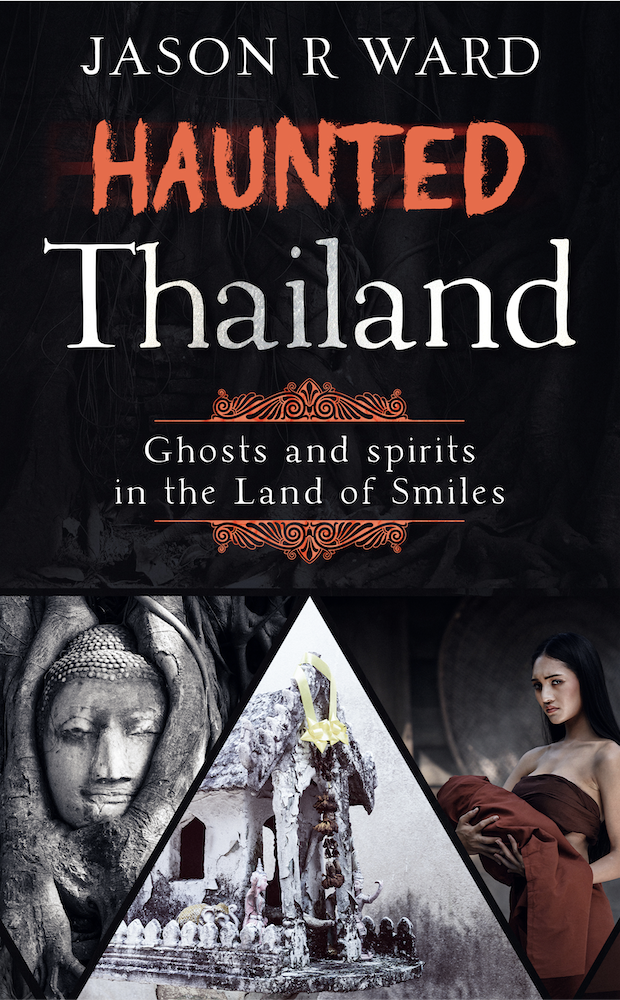
The following extract from my short book Haunted Thailand: Ghosts and Spirits in the Land of Smiles looks at three of the gentler female spirits said to inhabit the country’s trees, homes, and shops. They still have their moods, of course (this is this is folklore after all, but compared to the Krasue, they’re practically angels.
Not all Thai ghosts are into entrails or revenge. There are some nice ones to balance the spiritual world out and allow the Thais to occasionally get a good night’s sleep.
Let’s start with a couple of beings that aren’t technically ghosts but are more benevolent spirits that are particularly fond of trees. They are collectively known as Nang Mai, and there are two that are well known.
Nang Mai
Nang Ta-kian
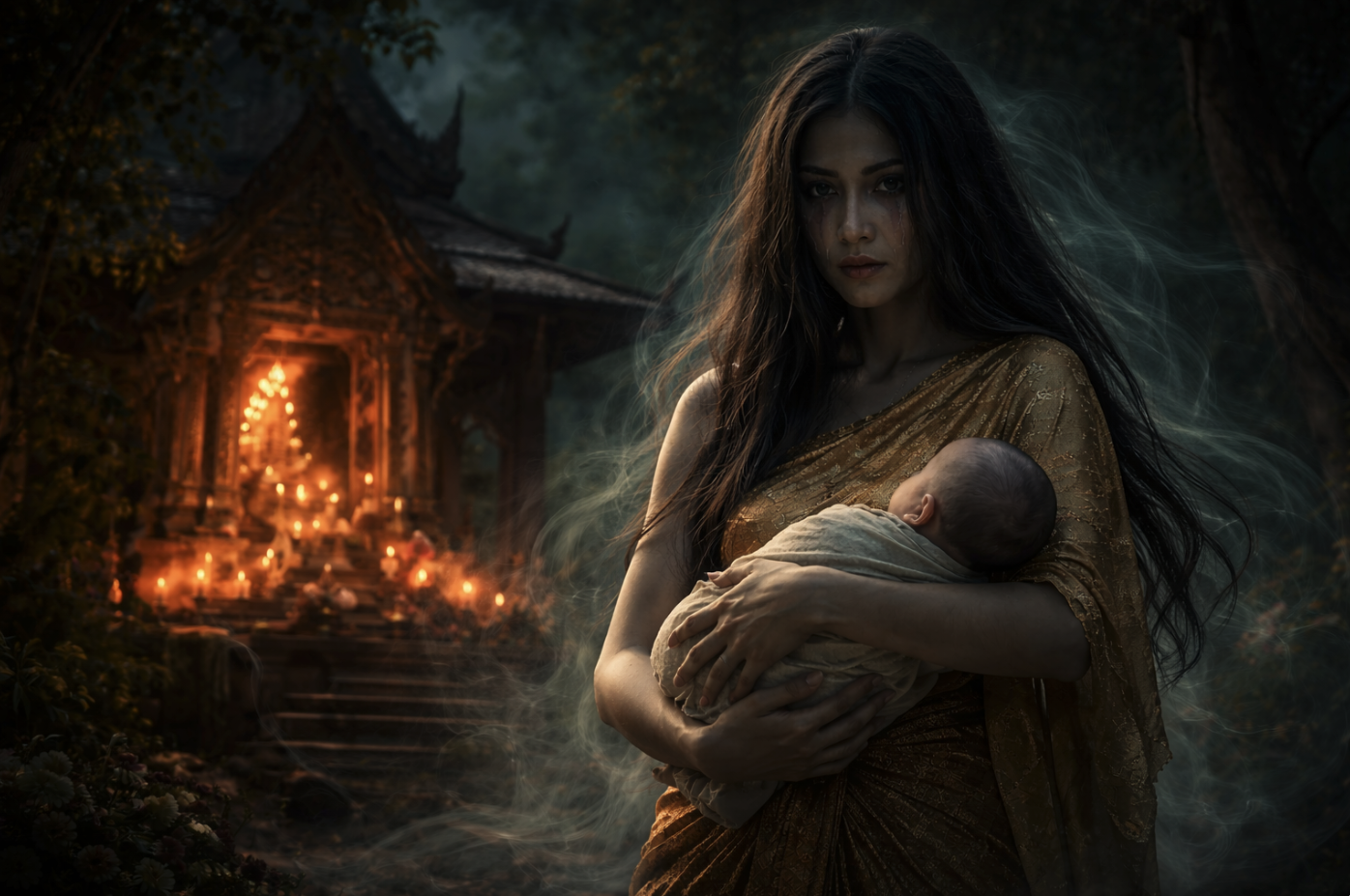
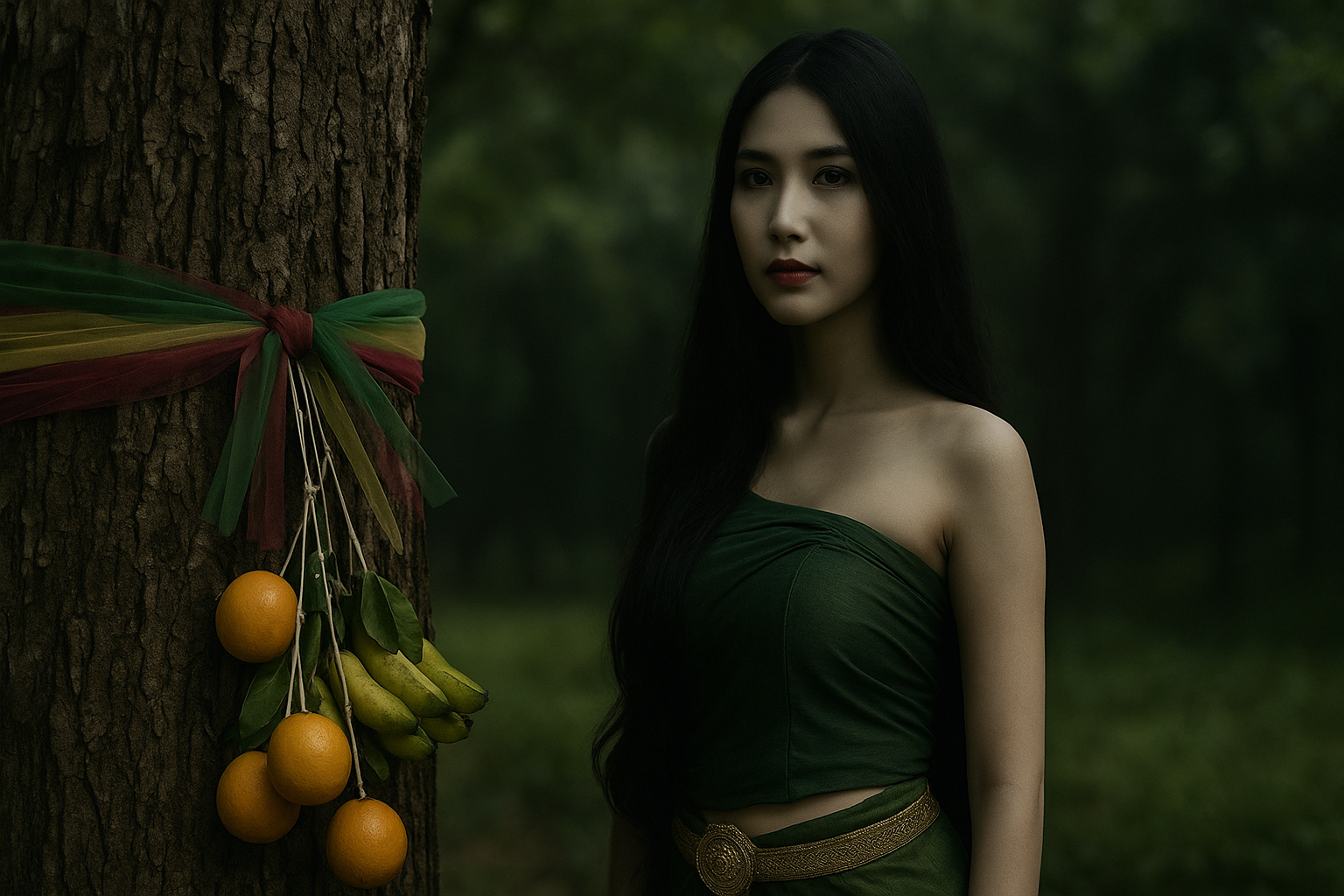
A Nang Ta-kian is a ghost/spirit/fairy that inhabits the Ta-kian tree (aka Hopea odorata trees). They usually appear as beautiful young women dressed in traditional Thai clothing that is reddy-brown in colour.
The Ta-kian tree is huge and has a large root system, meaning it is not normally found near people’s houses. Which is fortunate because Nang Ta-kian is a local lass who prefers to haunt the immediate environment around her tree. If you cut down a Ta-kian tree and use it to build parts of a house, the Nang Ta-kian is likely to follow and haunt you, and generally make your life miserable.
As this ghostly anger is known, Ta-kian trees are not used for lumber in Thailand, with one exception – monasteries. Because Buddhist monks are so nice and filled with merit, they have the ability to nullify the Nang Ta-kian. In case someone wants to risk it, or is unaware, Buddhist monks and locals will wrap lengths of coloured satin cloths around the trunk, and if the tree absolutely has to come down, then a special ceremony is required as the consent of the spirit needs to be granted.
Generally speaking, if you are a good and decent person, you have nothing to fear from a Nang Ta-kian, but they are known to hurt evil people who make the mistake of wandering too close.
Nang Tani or Pii Tani
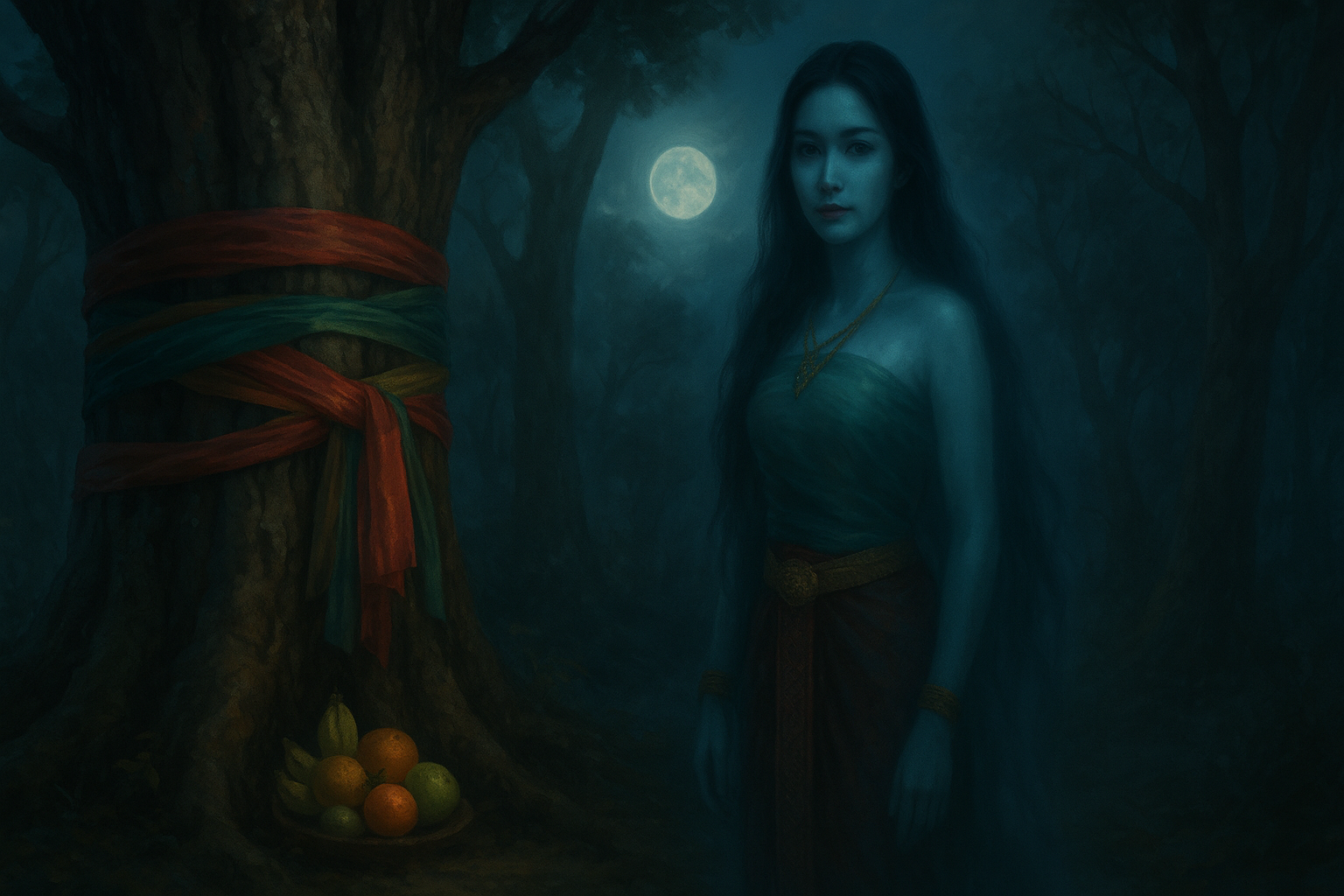
Like the Nang Takian, the Tani is an attractive young woman who is a spirit connected to a tree. The Tani however, prefers to wear a green traditional costume to match her favoured locale – wild banana trees. Most of the time, they just hide out in their tree, but come the full moon, the Tani will make an appearance. As well as green clothes, she is also described as having greenish skin, to match her tree. However, she contrasts this with full red lips and long, untied black hair.
As with the Nang Ta-kian, it is not advisable to cut down her tree or any tree nearby. Any trees thought to be inhabited by a Tani also have lengths of coloured satin tied around them.
A Pii Tani is also considered benevolent most of the time. There are stories in Thai oral tradition that say she might harm men, especially those who have harmed women. There are even tales that she might seduce men during the full moon into having sex with her. Other versions suggest that if a man pees on the tree, or for some depraved reason rubs his penis on it, she will consider it flirting.
While this may sound intriguing and even appealing to some desperate and depraved types, it should also be pointed out that once you have sex with a Tani, she becomes a tad possessive. If you have sex with another woman after, she will kill you.
But if you manage to avoid rubbing your todger on trees and are generally a decent person, then a Nang Tani is pretty nice. There are even stories of Tanis giving food to passing monks.
The Nang Ta-kian and Nang Tani are collectively known as the Nang Mai and are very popular in Thai culture. If you see coloured cloth and offerings tied around a tree in Thailand and neighbouring countries, pay respect and behave.
Nang Kwak
Like the previous two, a Nang Kwak is more of a spirit than a ghost. She is one of the good ones, however, and is believed to bring good fortune – usually literally, in the form of cash. An image of Nang Kwak is likely to be found in Thai households and will almost definitely be found in nearly all Thai shops as she is the patron of the Deity of Merchants and Salesman, credited with bringing in customers and creating prosperity in any business establishment.
She is normally dressed in Thai traditional clothing, but this time they are normally red. (Although not always.) Nang Kwak is also usually depicted as wearing a golden crown and is seated or kneeling. Her right hand is raised but with the palm facing inward and the hand down, in the Thai way of beckoning someone, in this case, a customer – this is also how a Thai would call a taxi. Her left hand is normally at her side or, in slightly less subtle imagery, holding a bag of gold.
Although she is a kind of household spirit, she is more than that. Her iconography is similar to that of Phosop – the Thai rice goddess of whom she seems to be an incarnation. However, it gets more complicated than that because her iconography is actually based on the Hindu goddess Sri Lakshmi, who is also the goddess of wealth, fortune and prosperity.
To cut a long story short, Nang Kwak is good and will get you cash. You may see her image on a poster or piece of cloth in a shrine in a shop, or, if the businessperson travels a lot, she can be carried in amulet form.
I hope you enjoyed this. If you want to read more about Thai ghosts, spirits and folklore, please check out my (cheap) book on the subject:
Haunted Thailand: Ghosts and Spirits in the Land of Smiles by Jason R. Ward