

















The Unbelievable True Story Of The Only Person To Be Hit By A Meteorite
Ann Hodges was planning on a nap when a meteorite came through the roof
I don’t want to be an alarmist, but meteorites hit the planet with terrifying regularity. For example, a five-meter-sized rock hits the Earth, on average, about once a year. However, the damage caused isn’t as bad as you’d think. Other types of space rocks, such as the asteroid that killed the dinosaurs, happen once every 100 million years or more and are as bad as you’d think.
So it’s probably best not to think about it.
While common, very few meteorites have affected people in any significant way, and there is only one confirmed case of someone being directly struck by one. But I’ll get to the unfortunate Ann Hodges in a second.
First, a quick rundown on the difference between asteroids, meteoroids, meteors, and meteorites
(Skip this bit if you just want to read about the epically unlucky Mrs Hodges.)
Asteroids. These are found in space and most orbit the sun. They aren’t as big as planets, but they are bigger than meteoroids. They rarely hit the Earth, but when they do, they are devastating due to their size – ask the dinosaurs.
Meteoroids. These are much smaller pieces of asteroids (frequently the result of collisions) or bits of rock from comets.
Meteors. When a meteoroid hits the Earth’s atmosphere, it vaporises in a streak of light across the sky. Aka – shooting stars.
Meteorites. Meteoroids that are large enough not to burn up completely and make it to the surface are called meteorites.
(I hope this helped.)
Some of the better-known recent meteorite strikes
Large meteorites, such as the one that struck Chelyabinsk, Russia, in 2013, occur roughly every 20 years. That rock was roughly 15 meters across, weighed around 7000 metric tonnes, and injured approximately 1200 people. There were no reported fatalities with the vast majority being hurt by shattering glass. Still, it must have been terrifying.
The Chelyabinsk rock was the largest meteorite since the Tunguska event in 1908, which was also in Russia. That strike saw a stony meteoroid, estimated to be about 50 to 60 meters across, smash into eastern Siberia. It levelled 80 million trees in an area covering 2150 square kilometres (about 830 square miles).
Although the vast majority burn up in the atmosphere as meteors or strike in the middle of nowhere, there have also been cases where humans have been buttock-clenchingly close to being struck.
For example, in 1992, in Peekskill, New York, a 26-pound meteorite smashed through a lady’s car. More recently, in 2016, a gentleman in southern India was initially thought to have been the first person killed by an extraterrestrial rock. However, NASA later confirmed it was not the case – whatever caused the explosion that killed a man is unlikely to have come from space.
There are several other stories of meteorites nearly hitting humans and the odd claim of a death or two, but none have been confirmed. Our four-legged friends have been less fortunate. One hit a dog kennel in Costa Rica, narrowly missing the dog. It was lucky, unlike a cow that was confirmed killed by a meteorite in Venezuela in 1972.
At the time of writing, the most famous and confirmed case of someone being struck by a meteorite is the sad and unlikely story of Ann Elizabeth Fowler Hodges.
The Sylacauga meteorite and the unfortunate Ann Hodges
On the afternoon of the 30th of November, 1954, people in Georgia, Mississippi, and East Alabama reported seeing “a bright reddish light, like a Roman candle trailing smoke”. Others described it as “a fireball, like a gigantic welding arc”.
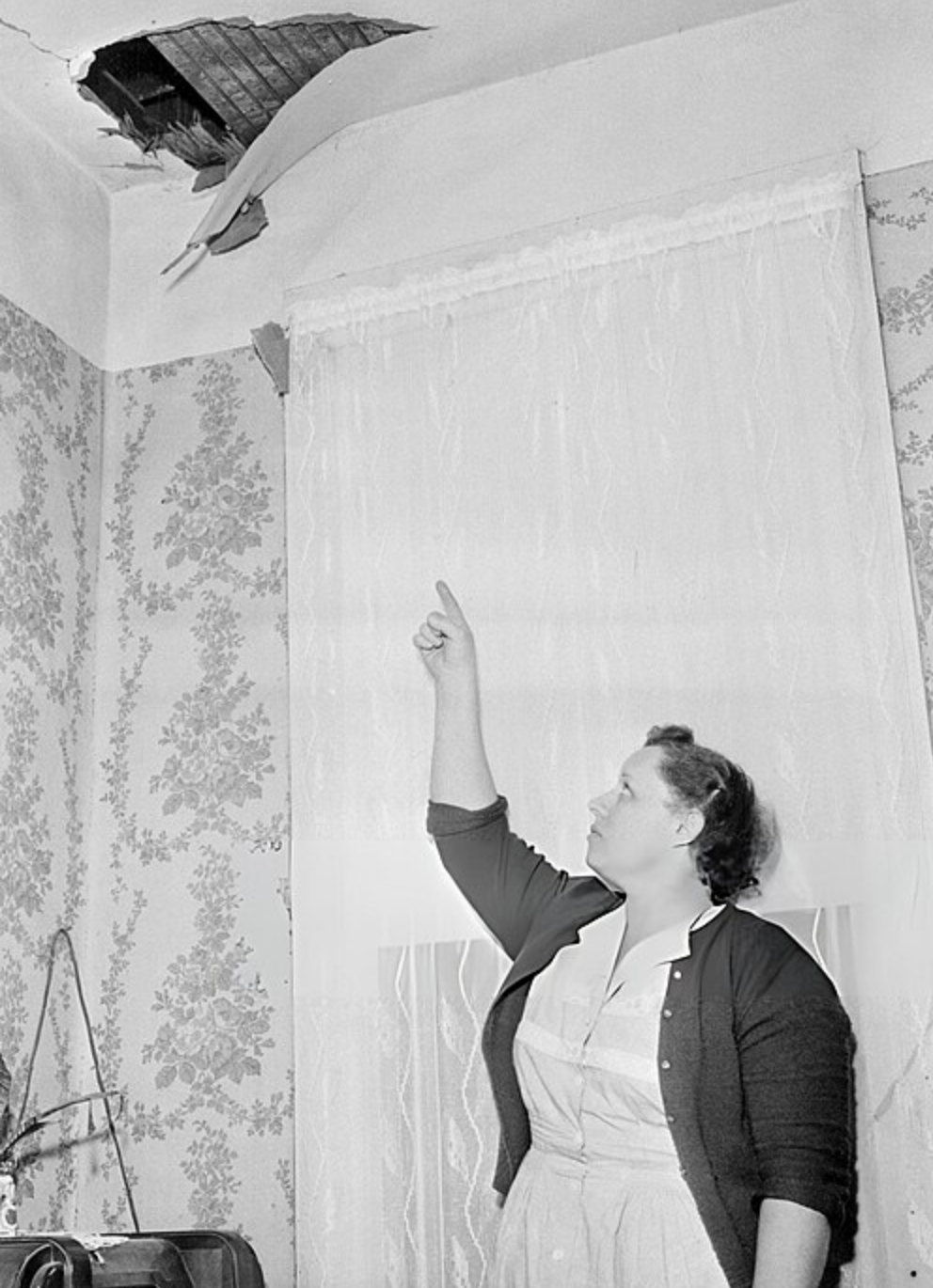
The reports were muddled with some concerned it was an aeroplane going down or, given the Cold War was in full swing, possibly even a missile. The fireball arced across the sky before striking the ground in Sylacauga, Alabama. To be more precise, it smashed through the roof of a rented house.
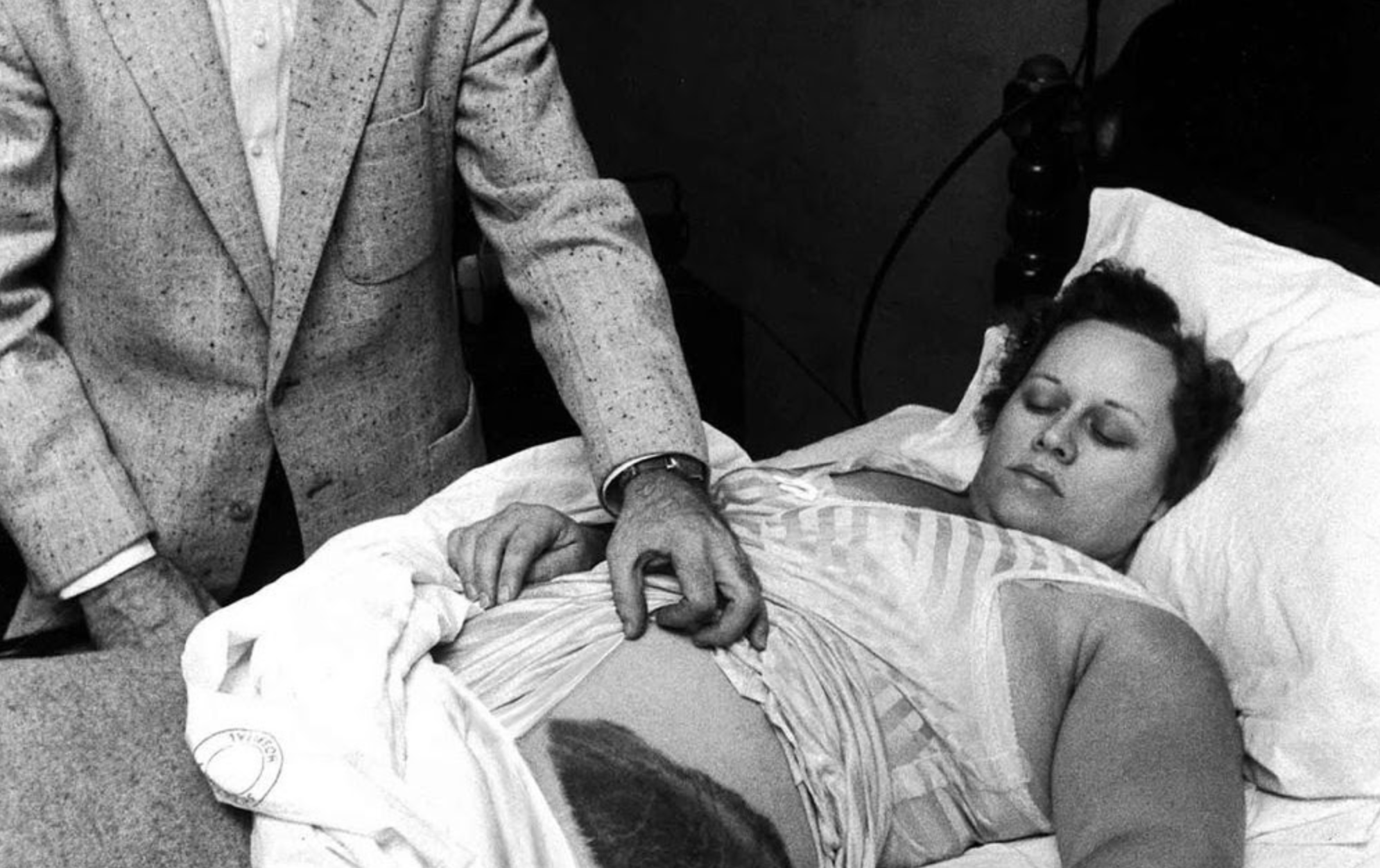
Ann Hodges had been relaxing on the sofa when an 8.5-pound meteorite shot through the roof, hit her radio console, bounced off and struck her on the upper thigh.
At the time, it wasn’t immediately clear what had happened. Ann and her mother were understandably confused by all the dust and sudden chaos. Then they spotted a rock on the floor, a hole in the ceiling and a massive bruise on Ann’s upper thigh.
The mother and daughter immediately called the police and fire departments. A government geologist, who happened to be working in a nearby quarry, was also summoned.
Soon, curious bystanders were gathering at the Hodges’ house, with many still speculating as to what had really happened. When Ann’s husband Eugene returned from work that evening, he rather alarmingly discovered a milling crowd outside his home and dashed inside.
Happily, apart from a colossal bruise, Ann seemed ok. However, the following day she was moved to a hospital. She was suffering, entirely understandably, from insomnia.
The police handed the rock over to the air force for examination. The geologist examined it and confirmed it was a meteorite.
The next question that arose was who the rock’s rightful owner was. Meteorites can be valuable.
The story had been highly publicised, and the general consensus was that Ann should keep the meteorite. She agreed, saying:
“I feel like the meteorite is mine. I think God intended it for me. After all, it hit me!”
Unfortunately, things weren’t that simple. The house was rented, and the landlady claimed the meteorite was rightfully hers.
A legal dispute. The rock finds a new home
The Hodges’ landlady, the interestingly named Ms Birdie Guy, hired a lawyer and sued the couple. She claimed that as the meteorite had landed on her property, it was rightfully hers. Legally, she was correct. Unfortunately for her, the public was overwhelmingly on Ann’s side.
Eventually, it was settled out of court, with Ann paying Ms Guy $500. Eugene was keen to keep it, as he had high hopes of making some decent money from selling it. His belief was justified, as shown by another resident of Sylacauga, a farmer called Julius McKinney, who found another piece of the same meteorite.
When the Sylacauga meteorite was shooting toward the ground, it had split into multiple pieces. One piece would go on to strike the slumbering Ann, but another landed on a nearby road.
That afternoon, McKinney was driving his mule-drawn carriage, and his mules acted weirdly hesitant to pass a chunk of strange rock in the road. McKinney moved it out of the way and continued home. That night, on hearing the news about Ann Hodges, he realised the rock he’d seen might well be another piece of the meteorite. He returned, found the stone, and sold it.
There is no record of how much he earned from the sale, but it was sufficient to purchase a house and a car. So it must have been decent. Interestingly, a piece of McKinney’s meteorite sold at Christie’s in 2017 for $ 7,500, which is $728 per gram (gold was $39 per gram at the time).
Unfortunately, Eugene and Ann Hodges had no such luck. After unsuccessfully trying to sell it, the meteorite was used briefly as a doorstop before finally being donated to the Alabama Museum of Natural History.
While all this had been going on, Ann Hodges had become a minor celebrity. She appeared on the cover of the December 1954 edition of Life magazine and was featured on multiple nationwide news stories.
Tragically, her newfound fame proved too much to cope with. Ann had a nervous breakdown and experienced multiple ongoing health problems. Her marriage broke down in 1964, and in 1972, Ann died in a nursing home of kidney failure. She was only 52.
Don’t panic…
If you are worried, keep in mind that the odds of being hit by a meteorite are… astronomical. Astronomer Alan Harris calculated the odds of dying from a meteorite strike are 1 in 700,000. If that sounds more likely than you’d care for, Harris’s calculation is based on a large-scale event with people being killed by the blast or a resulting tsunami – rather than one person being literally struck dead by one meteorite.
Ann Hodges had simply been incredibly unlucky.
I originally wrote this on Medium. You can find a lot of similar stories there in my Intriguing TImes publication.