


















Birthdays around the world can weird, fun, and unexpected
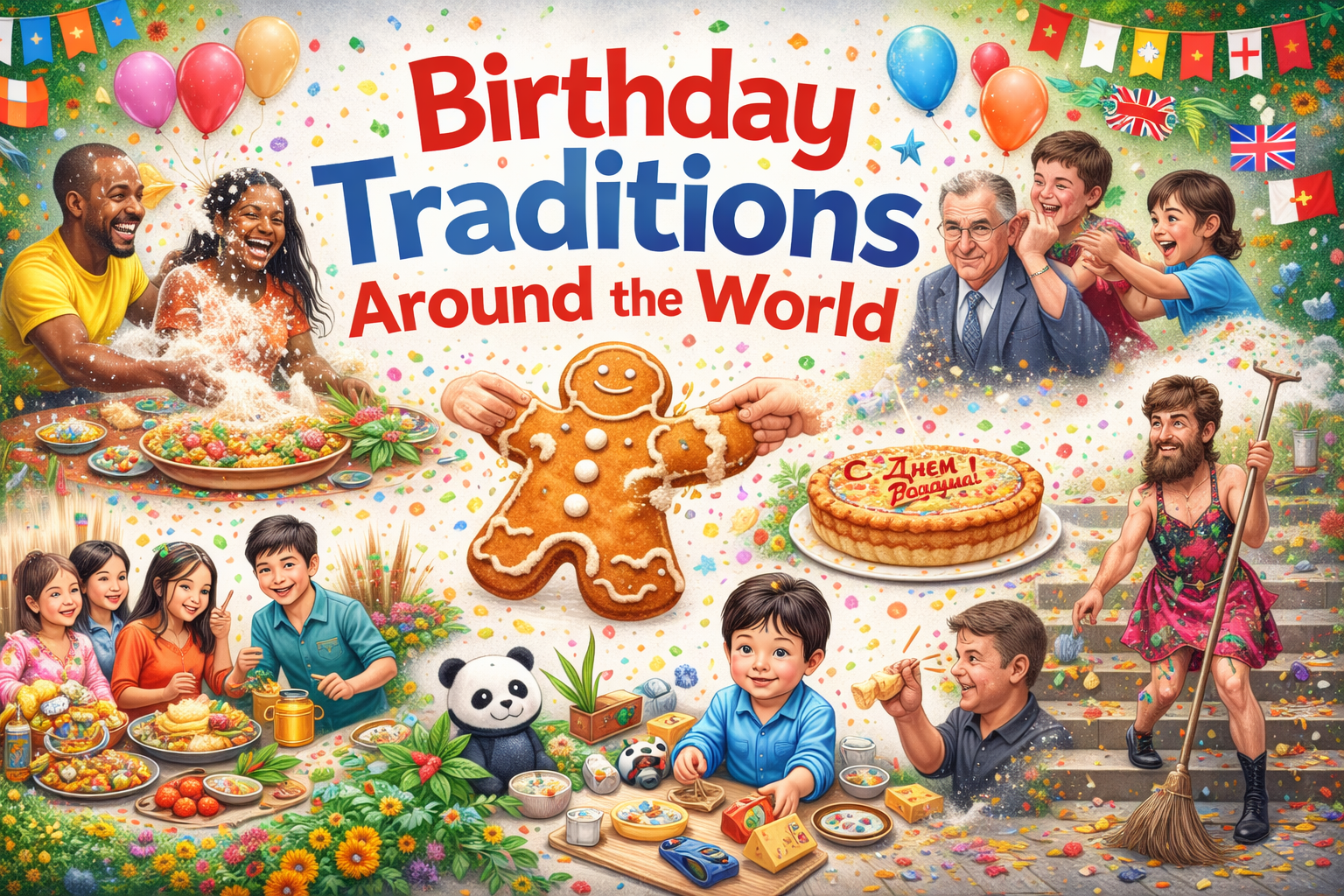
Getting older is universal, but how people celebrate the inevitable joys of ageing and birthdays varies widely from culture to culture. Some traditions are purely fun, while others reveal deeper insights into the values and beliefs of different cultures.
This article came about when I was travelling in Asia and saw some of these first-hand. I wanted to learn more. I have fact-checked these, but bear in mind that experiences differ even within the same country.
Some countries don’t celebrate individual birthdays
Bhutan doesn’t celebrate personal birthdays
In Bhutan, individual birthdays aren’t commonly celebrated, and many people don’t even know their exact birth date. This is partly because Bhutan follows its own calendar, which doesn’t align perfectly with the Gregorian system, but also because personal birthdays aren’t seen as particularly significant in their culture.
Instead, for administrative purposes, everyone in Bhutan officially adds a year to their age on January 1st. This collective approach has even apparently caused confusion at customs when entire Bhutanese delegations appear to share the same birthday.
Bhutan, which famously measures Gross National Happiness (GNH) instead of GDP, places less emphasis on individual milestones and more on collective well-being. Even though younger generations are increasingly recognising their specific birthdays, the entire country celebrates their birthday on New Year’s Day. The 2nd of January is thankfully a public holiday.
Vietnam’s mass birthday
The concept of a “countrywide birthday” also exists in Vietnam, but it is slightly more confusing. Everyone grows a year older during Tet, the Vietnamese Lunar New Year. Since Tet’s date changes annually, knowing your “birthday” for the following year requires consulting next year’s calendar. Consequently, in January or February, whenever Tet falls, there are huge celebrations that often last up to a week and include feasts, family reunions, and traditional activities.
Interestingly, age is counted differently in Vietnam: babies are considered one year old at birth, meaning Vietnamese of the same biological age will be a year older than everyone else.
The weird and the boisterous
Ear tugging in Hungary
In several countries, especially Hungary, ear tugging is a playful tradition to mark someone’s birthday. The number of times a birthday boy or girl has their ears tugged is the same as their age. This is usually done before gifts are given, presumably to ensure the child doesn’t run off.
This is accompanied by a Hungarian song that translates roughly as: “Bless you, live so long your ears reach your ankles.” While less common, variations of this custom can sometimes be found in Italy, Brazil, and Argentina.
Give them the ‘Bumps’!
Popular in the UK and Ireland, “the bumps” involve lifting the birthday celebrant by their wrists and ankles, hoisting them into the air, and gently lowering them to the ground. This process is repeated as many times as their age. Naturally, older celebrants tend to escape this tradition for practical reasons.
When I was young and in the UK, I received the Bumps more than once, but the tradition seems to be dying out. This is a good thing, as the Bumps are simultaneously fun and terrifying. I have seen someone hit a low ceiling, almost break their nose, and then hit the floor hard as everyone panicked about the initial scream of pain. So maybe this one can be safely forgotten.
Quirky and delicious customs
Decapitating cakes in Denmark
Danish children celebrate with a human-shaped cake known as kagemand (or kagekone for girls). While delightful at first glance, the cake is dramatically decapitated before the birthday child, who receives the severed head as their portion. The rest of the cake is devoured enthusiastically by friends like a pack of zombies (I’m guessing).
Russian birthday pie
In Russia, they don’t muck about with cake and instead opt for a practical and hearty birthday pie. These pies often feature a special birthday message engraved into the crust – an alternative take on the typical frosted cake.
The fun and the not so fun…
Getting floured
In Jamaica and parts of the Caribbean, it’s common for friends to throw water on a birthday celebrant and then cover them with flour. This tradition, while messy, is meant to be light-hearted and fun and not to humiliate. Even Usain Bolt has been subjected to it, famously being floured on his birthday during the Beijing Olympics.
Buttering the nose in Canada
Slightly more humiliating is a Canadian birthday tradition prevalent in Nova Scotia and Prince Edward Island, where birthday celebrants might find themselves pinned down as their noses are greased with butter. The idea is to make them too slippery for bad luck to stick to them.
Thirty-year-old German bachelors dress as women and do chores
In Germany, if a man turns 30 and is still single, he’s set a peculiar task: sweeping the town hall steps, often while dressed in drag. This chore is meant to demonstrate eligibility for marriage and is typically accompanied by a lot of good-natured teasing (and alcohol). Younger children, by contrast, enjoy a day free from chores and homework.
Banned birthdays in North Korea
In North Korea, birthdays on July 8 and December 17 are forbidden. These dates commemorate the deaths of Kim Il-sung and Kim Jong-il, and citizens are expected to mourn instead, which would put a dampener on things. Consequently, the estimated 100,000 people born on these days have ‘ghost birthdays’, and many reportedly change their official birthdates instead.
The Chinese have more than most
China has birthday traditions throughout a lifetime
In China, birthdays are important, and numerous traditions occur as someone ages. They have so many, in fact, that they get their own section. And I’ll still miss some.
However, certain things hold true for every birthday, including the colour red being lucky and never giving someone a watch, as it marks the passing of time is a reminder of death.
The first birthday
As in Vietnam, a child is born at age one. So, the first birthday celebration a year after the birth, will see the baby turning two. There are a couple of interesting traditions here.
The ‘zhua zhou’ (spellings vary) is an activity where various job-related objects are placed in front of a baby. So, for example, a pen (for a writer), a football, a musical instrument, a stethoscope, a model aeroplane, or even a modern computer mouse for a budding IT expert. Whatever the baby picks up is supposed to predict their career. This system seems ripe for abuse from parents with high ambitions for their offspring, but it is actually just a bit of fun.
Instead of a cake, another enjoyable tradition is the consumption of the delicious-sounding ‘longevity noodle’. This is a single egg noodle that is long enough to fill an entire bowl. The baby is expected to suck the noodle down in one mighty slurp. Any cutting of the noodle symbolises a shortening of life, so it is possibly traumatic for superstitious parents. Fortunately, the ‘longevity noodle’ is an ongoing birthday tradition, so an accidental severance one year can be rectified the next.
In China, specific ages are important.
For a Chinese female, age 30 is seen as a year of confusion and risk. So, they take the logical solution — skip it and stay 29 for another year. Age 33 is a bad luck year, but fortunately, women can defeat it by ignoring any celebration and cutting a piece of meat 33 times. The highly slashed meat is then discarded. This is repeated at age 66, with the meat being slashed 66 times. In deference to age, this duty can be delegated to a daughter or close female relative.
Similarly, men often opt to avoid the age of 40 by staying 39 for an extra year. A tradition I am all for.
As you may be aware, the Chinese zodiac comprises 12 signs, one for each year. Consequently, 60 is considered a full life cycle and particularly auspicious. This usually results in a banquet, which the lucky birthday celebrant gets to pay for. Generally speaking, the Chinese aren’t all that big on birthdays until they hit 60. Then they go big.
Finally, a strange tradition happily lost to history: Full teeth removal
This tradition began in the 19th century but was particularly popular in the first half of the 20th century in places like the UK. When you turned 21, it was common to be given the gift of having all your teeth plucked out.
This stemmed from dental work being expensive and oral hygiene being poor. So, for less well-off families, the obvious solution to avoiding a lifetime of dentists was the extraordinary gift of paying to have all teeth removed and replacing them with dentures. It was surprisingly common and lasted right up until the end of the 1940s and the establishment of the NHS.
What can we learn from all this jollity?
While the specifics differ, birthdays around the world share a common thread: they’re an opportunity to celebrate life, connections, and cultural values.
From Denmark’s decapitated cakes to Bhutan’s collective New Year birthdays, these customs show the diversity of human creativity and joy. Some people – like myself – mope and complain with every passing year. But ageing is inevitable, so why not embrace it with a little fun and tradition along the way?