






The Potsdam Giants: How A Prussian King’s Obsession Led To Kidnapping, Torture, And Eugenics
The true but dark story of an incredibly tall regiment
This post originally came from my Substack – Intriguing Times. But it’s now behind a paywall, and is such a great story, I thought I’d share it here. Enjoy…
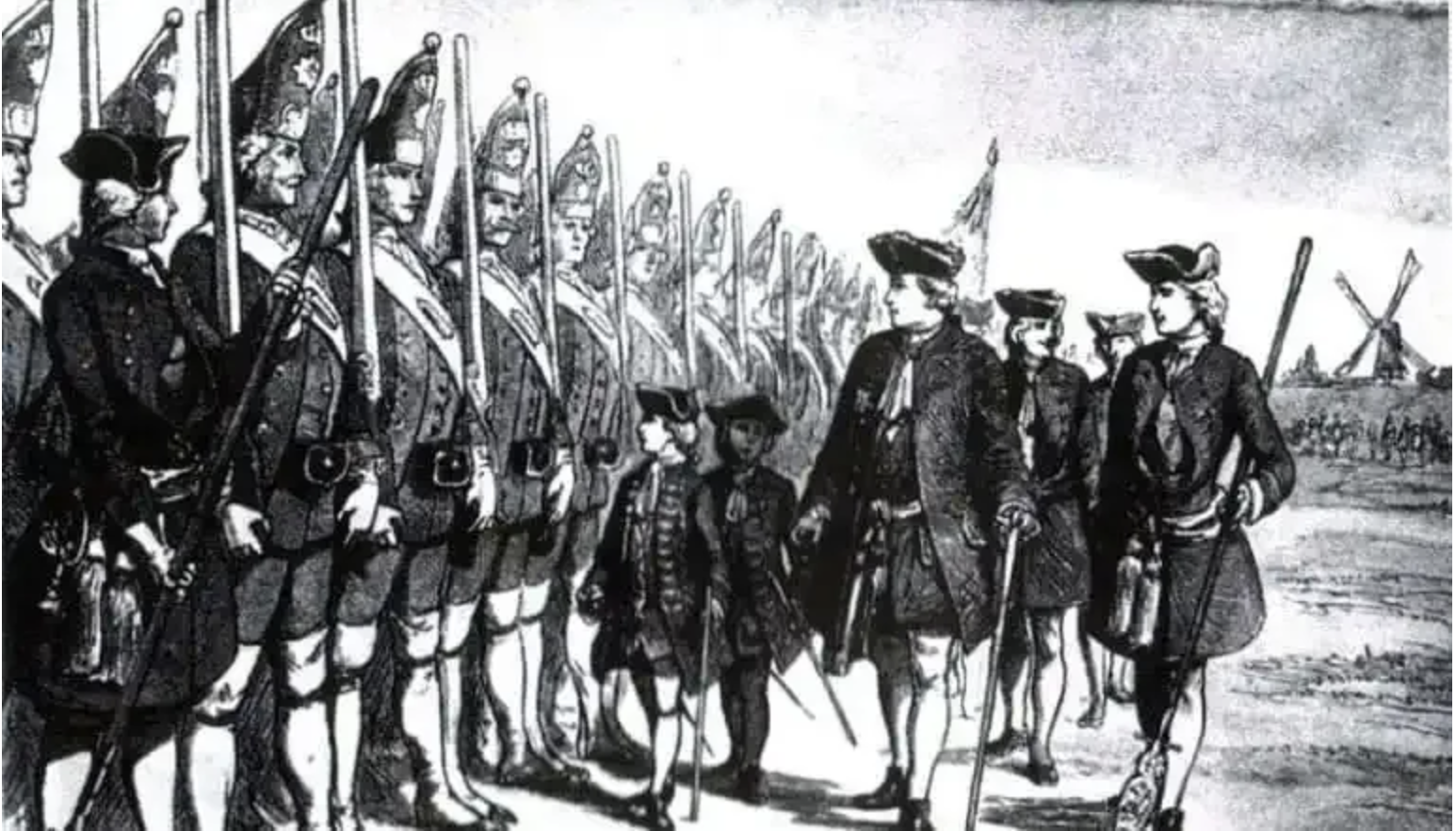
King Frederick William I of the German kingdom of Prussia had ambitious military plans. In 1713, he became the King, and for the next twenty-seven years, he massively expanded his army from 38,000 soldiers to 83,000. The king paved the way for his son, Frederick the Great, to turn Prussia into a military force to be reckoned with.
However, Frederick William had a strange obsession with particularly tall men. This led to the creation of a personal regiment of them, who became known as the ‘Potsdam Giants’. Some of these giants joined voluntarily, but others were given as gifts or even kidnapped. Even more disturbingly, the king tried to ‘breed’ tall people in an early attempt at eugenics.
Who could become one of the Potsdam Giants?
Although officially known as ‘The Grand Grenadiers’, nearly everyone called them the ‘Potsdam Giants’ or ‘Lange Kerle’ (The Long Guys). The regiment’s only entry requirement was to be six Prussian feet tall (about six feet two or 1.88 meters) or above. The taller, the better, as the soldiers’ pay was based on their height.
The ‘Giants’ didn’t have to be Prussian and came from all over the world. And Frederick William eagerly obtained them by any means possible. Some were recruited from other armies or regiments, and some volunteered.
As his regiment and passion for tall soldiers grew, foreign leaders, such as the Sultan of the Ottoman Empire and Tsar Peter the Great, sent numerous tall soldiers to improve relations.
However, others were kidnapped, sold to the regiment, or even more disturbingly, bred for the role.
Always looking for new recruits, Frederick William would pay fathers for any especially lofty sons and purchase tall farmhands from landowners. Particularly large newborn babies were tagged with red scarves on the off chance they grew tall. The populace was happy to help as the king was rich and keen to pay.
Kidnapping, eugenics, and the unfortunate consequences
An early attempt at eugenics
While the above options proved successful, they didn’t fully satiate the king and his compulsive need for more tall men. To rectify this, he turned to darker methods.
Frederick William turned to eugenics, pairing his giants with notably tall women with the aim of producing colossal offspring. And it worked. By the end of the 18th century, Potsdam was full of unusually lanky people.
Even Charles Darwin commented on this breeding program in his famous publication The Descent of Man. While discussing breeding livestock for certain traits, he said the same thing hadn’t been tried with humans – with one exception.
“Nor have certain male and female individuals been intentionally picked out and matched, except in the well-known case of the Prussian grenadiers.”
This experiment that saw humans forced or encouraged to breed for certain traits, sadly did not end with Frederick William’s reign. Some have argued that the Nazi ideal of a master Aryan race of tall, blond, blue-eyed Germans can be traced back to warped versions of Darwinism and the eugenics of the Potsdam giants.
Kidnapping was common
The king seemed utterly untroubled by morals when it came to his beloved regiment, and he had no qualms when it came to activities like routinely kidnapping lofty men.
One of the tallest and best-known members of the regiment was an Irishman called James Kirkland, who was reputedly over seven feet tall. Kirkland was initially hired as a footman for the Prussian ambassador to London – the superbly named Baron Borck.
Unfortunately, the hiring had been a trap, and the moment Kirkland set foot on a Prussian ship in Portsmouth, he was bound, gagged and conscripted to the Potsdam Giants.
Cases of tall men being abducted and sent to Prussia were common, and such men formed a sizeable chunk of the king’s prized regiment. The king once even tried to abduct a particularly tall Austrian diplomat.
What was the point of the regiment?
There were some attempts at justification for the regiment, such as that loading a rifle was a bit easier for a taller man. But the arguments were generally pretty flimsy, with most arguing that sheer size was actually an impediment.
The truth seems to be that the king, who was allegedly around five feet five inches (some sources say five foot three), was simply obsessed with them.
Frederick William once admitted: “The most beautiful girl or woman in the world would be a matter of indifference to me, but tall soldiers – they are my weakness.”
Being in the regiment wasn’t entirely awful. The soldiers had the best food and accommodation available in the army. They were also ‘blessed’ with magnificent blue uniforms and an impressive 45cm hat designed to make them appear even taller. Another bonus, depending on the point of view, was that the regiment never actually had to do any fighting. At least not during Frederick William’s 27 year reign.
The Potsdam Giants’ job was purely ceremonial. But in truth, they were the result of a weird obsession and not to be envied. The penalty for desertion was death, and there was a reason for the severity of the punishment – lots of them wanted to get out. Life as a Potsdam giant was generally unpleasant.
Torture and degradation
One of the more notorious practices inflicted on the regiment members was an attempt to make the soldiers even taller. Frederick William had a special rack constructed to try and stretch the men to higher heights. While the torture was underway, the empathy-deficient king would apparently watch while eating lunch. This wasn’t a gradual or gentle process either. The procedures ended because too many of his beloved soldiers were dying.
The weirdness of the obsession and treating the soldiers as freaks for entertainment became more evident when the king was sad or sick. He would have a parade where hundreds marched past, headed by turbaned Moors with musical instruments and the regimental mascot of a live giant bear. Apparently, this kind of display cheered him up.
Another of the king’s hobbies was to paint his soldiers’ portraits from memory. Being able to do this was just another aspect of his unhealthy fascination with his men.
The soldiers were clearly not there for military purposes, and there was no escape. Given that many were kidnapped or sold into the regiment, it was not a posting to be envied.
The eventual fate and dissolution of the regiment
Frederick William died in 1740, and by this point, the Potsdam Giants regiment numbered in the thousands – sources range from 2,500 to 3,200. These were clearly thousands too many for his son, Frederick the Great, who deemed them window-dressing and sent them to fight with normal combat units.
The Potsdam regiment itself was eventually dissolved in 1806, much to the relief of tall men and women everywhere.
If you enjoyed this story I have lots more on my Substack – Intriguing Times. If you prefer Medium, you can find me through this link.